
Vinci Stories · Editorial preview
The Hidden Skull in Holbein’s The Ambassadors
What changes when you stop looking at a painting straight on?
- Artist
- Hans Holbein the Younger
- Work
- The Ambassadors
- Date
- 1533
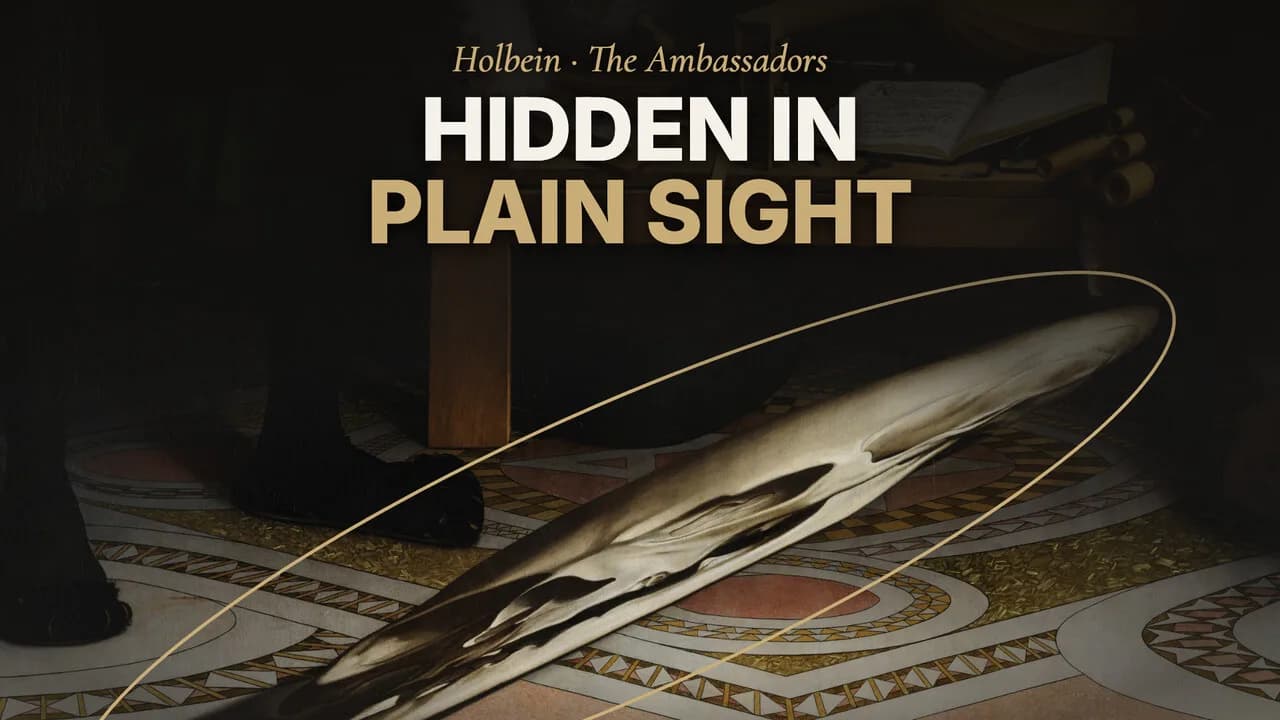
The film
A verified watch link, captions, transcript, approved image credits and video metadata will appear here after release approval.
Two finely dressed figures, instruments of measurement and an unsettling distorted form occupy the same painted world. Holbein’s composition rewards a second encounter: the angle of viewing changes what you can recognize.
The story behind the work
The picture creates an immediate contrast between confident portraiture and a shape that resists ordinary perspective. That tension is the entry point for the documentary.
Anamorphosis asks the spectator to move, not merely to look harder. The apparent distortion becomes intelligible from an oblique angle; a viewer’s position is part of the work.
The skull is central to many interpretations of the painting, but identifying a symbol is not the same as proving exactly what the artist wanted every viewer to think.
How to look closer
Start with the figures and the objects that surround them, then consider what happens when your eye encounters the shape in the foreground.
Compare the frontal view to the shifted perspective. Discuss the mechanics of anamorphosis separately from its possible meanings.
Ask what the painting gains by making the viewer physically change position to discover an image that was already there.
What the editorial team is checking
- Which parts of the image can be established by visual inspection?
- Which symbolic readings are scholarly interpretations?
- What happens to the experience on a small phone screen?
Know someone who should see this?
Send them the story of The Ambassadors.